

Home Lizards (Cicak) — helpful, but leaving droppings everywhere?
The house geckos that scurry across your walls at night eat mosquitoes, moths, and flies. They’re ecologically helpful — but the droppings on walls, ceilings, and curtains are a real complaint most Malaysian homeowners share.
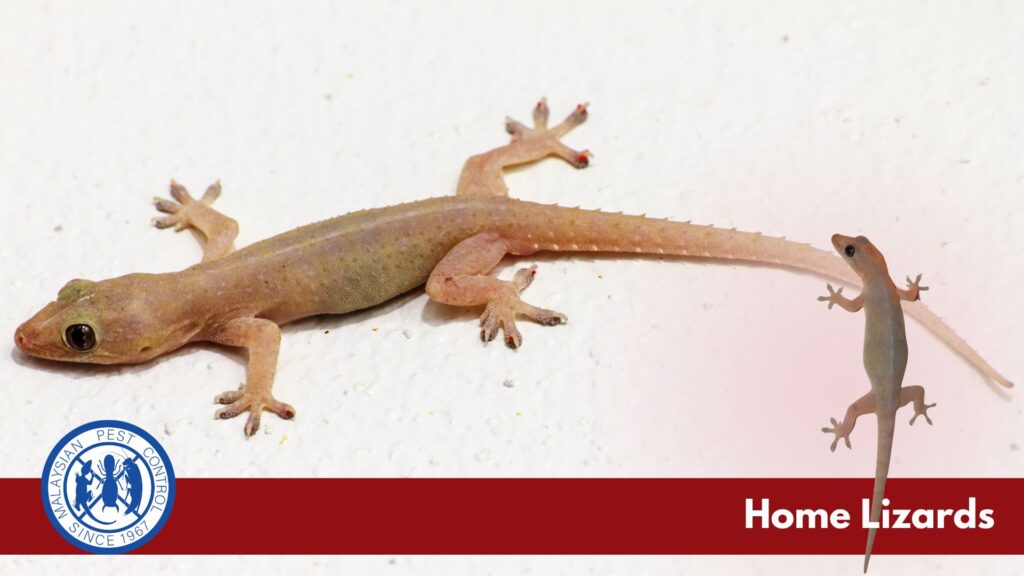
The two species most often found in homes.
When it comes to lizards commonly found in homes, which some consider pests due to their presence being unwelcome or simply due to personal discomfort, the species vary by region. However, two of the most commonly encountered types of lizards in and around homes in many parts of the world include the House Gecko and the Common Wall Gecko.
House Gecko (Hemidactylus frenatus)
Often seen on walls and ceilings, house geckos are small, usually measuring about 3 to 6 inches in length. They have soft, translucent skin, allowing some internal organs to be faintly visible, and their color can vary from light brown to gray. They are known for their distinctive chirping sounds — the classic “chak chak chak” heard in Malaysian homes at night.
Common Wall Gecko (Tarentola mauritanica)
These geckos are a bit larger and have a more robust build compared to house geckos. Their skin is rougher, with a mottled pattern that helps them blend into their surroundings.
How house geckos reproduce and grow.
Understanding how cicak populations grow explains why simply killing individual lizards rarely solves the problem — they reproduce quickly and colonise new spaces just as fast.
- Reproduction: Both species lay eggs, with house geckos producing clutches of two eggs several times a year. Wall geckos have similar reproductive habits, with slight variations depending on environmental conditions.
- Growth: Young geckos hatch from eggs fully formed and independent from birth. They grow rapidly in the first year and can live for several years, depending on the species and conditions.
- Adaptation: These geckos have adapted well to urban environments, finding ample food and shelter in human dwellings.
Nocturnal insect hunters, drawn to light.
Feeding Habits: Both species are nocturnal and feed on insects, making them natural pest controllers. They are particularly fond of moths, mosquitoes, and other small insects attracted to lights.
Habitat Preferences: While they are often found on walls and ceilings, these lizards prefer warm, humid environments and can be found hiding behind furniture, in wall cracks, or among potted plants during the day.
Are cicak actually dangerous?
The honest answer: no — they’re generally harmless. But that doesn’t mean their presence is welcome for everyone.
Pest Status: While these geckos are harmless and beneficial due to their diet of insects, they are often considered pests due to their droppings and sometimes their sheer numbers. They do not bite or pose any direct threat to humans or pets.
Disease Transmission: There is minimal risk of disease transmission from these lizards. However, like any wild animal, they can potentially carry bacteria or parasites that could contaminate surfaces.
The problem most homeowners raise isn’t the cicak — it’s what they leave behind.
Cicak droppings appear as small dark pellets with a white tip, scattered on walls, ceilings, curtains, and window sills wherever geckos rest during the day. They’re difficult to clean, unsightly, and can stain surfaces. Many of our clients don’t mind the cicak themselves — but they’ve had enough of the daily wiping.
What actually works to reduce cicak numbers.
Two basic approaches most Malaysian homeowners already know — but they only address the symptoms, not the root cause.
- Exclusion: Sealing entry points, such as gaps around doors, windows, and utility lines, can help prevent lizards from entering the home.
- Habitat Modification: Reducing outdoor lighting can help minimize insect attraction, indirectly reducing lizard populations. Removing standing water and debris can also limit lizard hiding spots.
Why we recommend not killing cicak directly.
It’s important to remember that these lizards play a beneficial role in controlling insect populations. Their presence is a sign of a healthy ecosystem. Considering humane and non-lethal management methods is encouraged to maintain biodiversity and ecological balance.
In summary, while house and wall geckos can be considered pests when they invade homes, their role in natural pest control often outweighs the negatives. Understanding their habits and ecological benefits can help homeowners make informed decisions about managing their presence.
Cut the food supply — and cicak numbers drop naturally.
Cicak reproduce fast, hide in crevices you can’t reach, and if you eliminate 10 of them today, more move in within weeks if the insects are still around. The root cause isn’t the lizards themselves — it’s the flying insect population that draws them in.
Reducing mosquitoes, cockroaches, ants, and flies means less food for cicak. Fewer feeding opportunities means fewer cicak taking residence — and dramatically fewer droppings to clean up.
Bonus: reducing mosquitoes and flies also protects your family from dengue and food contamination — so you get two problems solved with one treatment programme.
Some love them, some hate the droppings. We’ve helped both since 1967.
The insects cicak eat — and how we treat them.
Each of these pests is a food source for house geckos. Treating them reduces both the pest problem AND the cicak population feeding on them.
We also offer cicak repellents and physical exclusion on request.
For clients who prefer a direct approach — such as gecko repellent treatments, glue traps, or professional physical exclusion (sealing entry points) — WhatsApp us with your premise details and we’ll discuss options.
Other pests found in Malaysian homes.
If you found this useful, our other pest guides cover the most common insects and creatures you’ll encounter around the house.
 English
  简体中文
简体中文  Bahasa Melayu
  日本語
日本語  한국어
한국어  العربية