虫害  ›  关于蚂蚁  ›  Yellow Crazy Ants
虫害百科全书

Yellow crazy ants: erratic, invasive, ecosystem-disrupting.

Yellow crazy ants (细唇星虾) are one of the world’s worst invasive species. Named for their yellowish colour and frantic, unpredictable movement, they form supercolonies that displace native ants, disrupt pollination, and devastate local ecosystems. In Malaysia, they’re recognised as a biodiversity threat.

Invasive species Supercolony forming Biodiversity threat
Species
A. gracilipes
Stings
No (sprays acid)
Queen Lifespan
Several years
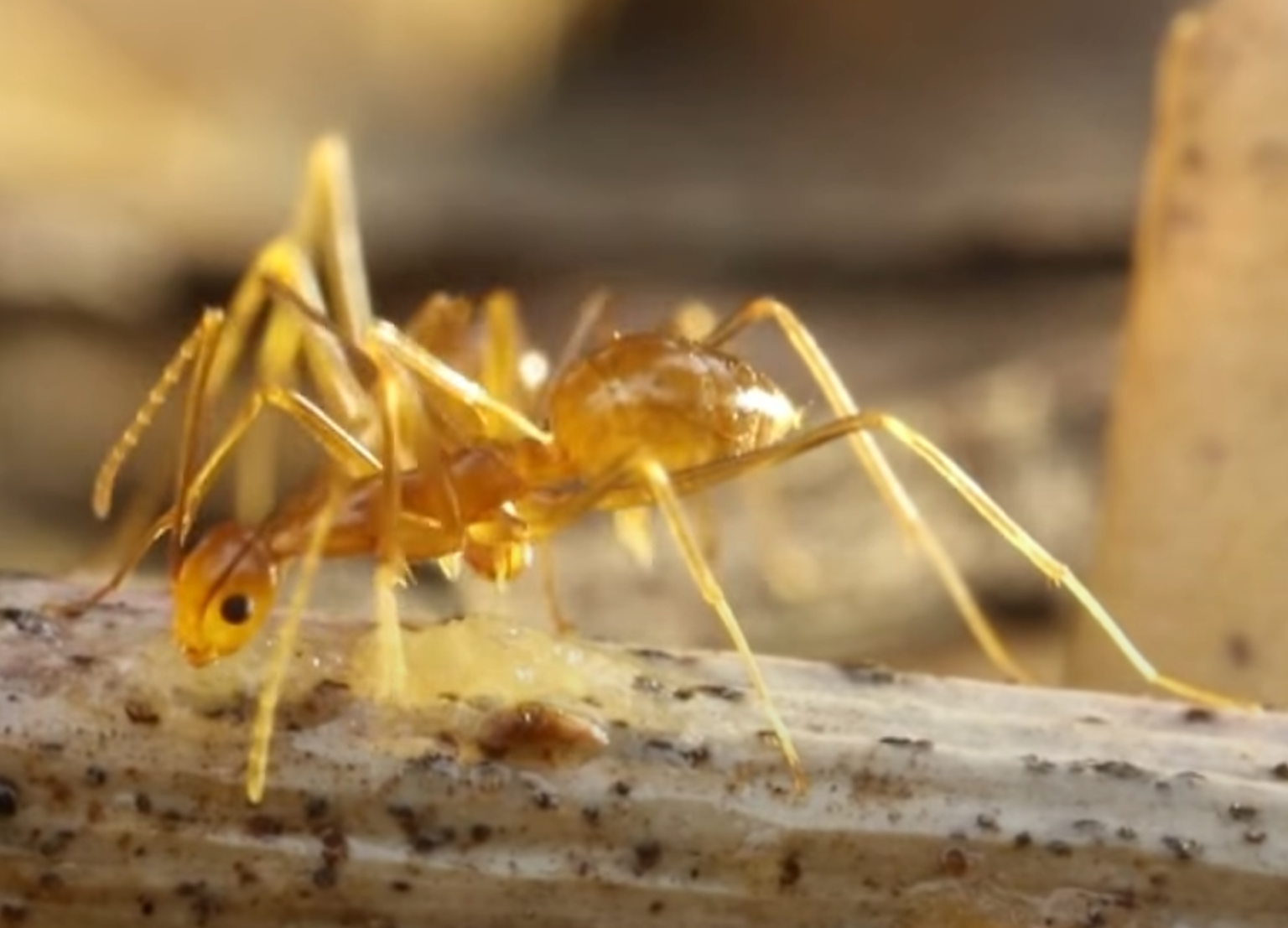
YELLOW CRAZY ANTS Yellow crazy ants (Anoplolepis gracilipes) — invasive ant species swarming on surface in Malaysian environment
See Them In Action

What “crazy” actually looks like.

Watch how yellow crazy ants move — the erratic, frantic pattern that gives them their common name and helps distinguish them from any other ant species you might encounter.

Field footage — note the frantic, scattering, unpredictable movement pattern. Their long legs and erratic walking is the signature behavioural ID for this species.
鉴别

How to recognise yellow crazy ants.

Two features make yellow crazy ants relatively easy to identify: their distinctive colour and disproportionately long legs, combined with their unmistakable erratic movement.

Species Profile
细唇星虾

The “crazy” ant with the long-legged silhouette.

Yellow crazy ants are 3–4 mm long, yellow to yellowish-brown in colour, with distinctively long legs and antennae that give them a slender, leggy silhouette. They don’t sting like fire ants — instead, they spray formic acid when threatened, which causes skin irritation and can be particularly harmful to small animals.

Listed in Malaysia’s official biodiversity records — see 🔗 MyBIS Malaysia species profile

尺寸
3 – 4 mm long
颜色
Yellow to yellowish-brown
Distinctive feature
Long legs & long antennae
Defence
Sprays formic acid (no sting)
Movement
Erratic, frantic, fast scattering
栖息地
Moist — rotting wood, leaf litter, wall cavities
The Name

Why they’re called “crazy.”

Most ants follow neat scent trails — one after another, in clear formation. Yellow crazy ants don’t. Their movement is frantic, scattered, and apparently random, with individuals darting in all directions at high speed.

This isn’t actually random behaviour — it’s a successful evolutionary strategy. The chaotic movement confuses predators and helps the colony explore new territory rapidly and unpredictably. What looks like panic is actually efficient territorial expansion.

生物学与生命周期

Four stages of development.

Yellow crazy ants undergo complete metamorphosis. Warmer Malaysian conditions accelerate every stage of their development, allowing colonies to expand year-round.

第一阶段

2 – 4 weeks to hatch

Queens lay eggs in secure, hidden nest sites. Warmer humid Malaysian conditions speed up hatching.

第二阶段

幼虫

3 – 4 weeks

Fed by workers, going through multiple molts. Development is highly temperature-dependent — heat accelerates growth significantly.

第三阶段

2 – 3 weeks

May or may not spin a cocoon depending on conditions. Adult ant body fully forms inside the pupal case during this stage.

第四阶段

成人

Workers months · Queens years

Workers immediately forage and expand the nest. Long queen lifespan + rapid worker production drives supercolony growth.

The Supercolony Phenomenon

Why yellow crazy ants are especially hard to control.

Unlike most ant species — which fight other colonies of their own kind — yellow crazy ants form supercolonies: networks of interconnected nests with multiple queens, all cooperating rather than competing. A supercolony can span hundreds of metres or even kilometres.

Many

Multiple cooperating queens

Most ant species have one queen per colony, fiercely defended. Supercolonies have many queens producing eggs simultaneously — rebuilding population faster than treatment can suppress.

No

No inter-colony aggression

Workers from one nest don’t attack workers from another. Ants travel freely between connected nests, sharing resources — making the “colony” extend across an entire property or neighbourhood.

Scale defeats DIY

Spraying one mound doesn’t matter — the supercolony’s other nests continue to thrive and rapidly repopulate the treated area. Surface-level treatment never reaches the multiple distributed queens.

An Unexpected Behaviour

They actively farm aphids — which damages crops.

Yellow crazy ants have a remarkable mutualistic relationship with sap-sucking insects like aphids and scale insects. They protect these pests from predators and parasites, in exchange for the sweet honeydew secretions the aphids produce.

The result: aphid populations thrive under yellow crazy ant protection, damaging far more crops and ornamental plants than they otherwise would. The ants aren’t directly destroying plants — they’re enabling other pests to do it at industrial scale.

Ecological & Economic Impact

The wider damage they cause — beyond your property.

Yellow crazy ants are listed among the world’s 100 worst invasive species by the IUCN. Their impact is environmental as much as economic, with one well-documented case demonstrating just how catastrophic they can be.

Global Case Study

Christmas Island — an ecological warning.

Christmas Island (Australia) is famous worldwide for its annual red crab migration — tens of millions of crabs moving from forest to ocean to breed. After yellow crazy ant supercolonies established on the island, they began killing millions of red crabs annually, devastating the entire forest ecosystem the crabs maintained.

The case is now cited globally as evidence of just how destructive yellow crazy ant invasions can become when left uncontrolled.

Malaysia & Local Impact

The threat to local biodiversity.

In Malaysia, yellow crazy ants pose multiple cascading problems:

  • Displace native ants — supercolonies outcompete local species for food and territory
  • Disrupt pollination — driving away or killing native pollinating insects
  • Reduce seed dispersal — affecting natural forest regeneration
  • Damage agriculture — via aphid protection and direct crop nuisance
  • Threaten small wildlife — formic acid spray harms small reptiles and amphibians
Yellow Crazy Ants vs Fire Ants

How to tell the two invasive species apart.

Both are invasive ants people often encounter in Malaysia. Identifying which one you have determines the right approach to control.

黄色疯狂蚂蚁
细唇星虾
火蚁
红火蚁
颜色 Yellow to yellowish-brown Reddish-brown, darker abdomen
尺寸 3 – 4 mm, distinctively long legs 2 – 6 mm, more uniformly compact
Defence Sprays formic acid — no sting Bites and stings — venomous, painful
Movement Erratic, frantic, scattering Organised mass attack when disturbed
Nest Hidden in litter, cavities, rotting wood Visible dome-shaped soil mounds
Colony Supercolony — many queens, multiple nests Discrete colony, typically one queen
Main risk Ecological / biodiversity Public health / direct stings
遇到虫害问题了吗?

Yellow crazy ants on your premise — the supercolony needs a strategy.

Because yellow crazy ants form supercolonies with multiple cooperating queens across distributed nests, single-point treatments don’t work. They rebuild within weeks. Our approach for yellow crazy ants involves perimeter-wide treatment, queen-targeted baiting, and follow-up monitoring to confirm the supercolony is fully suppressed. Send us a photo — we’ll confirm the species and recommend the right approach.

继续阅读

Other ants in our 害虫百科全书。.

Compare yellow crazy ants to other species we cover — each behaves differently and may need a different identification and control approach.

zh_CN简体中文